
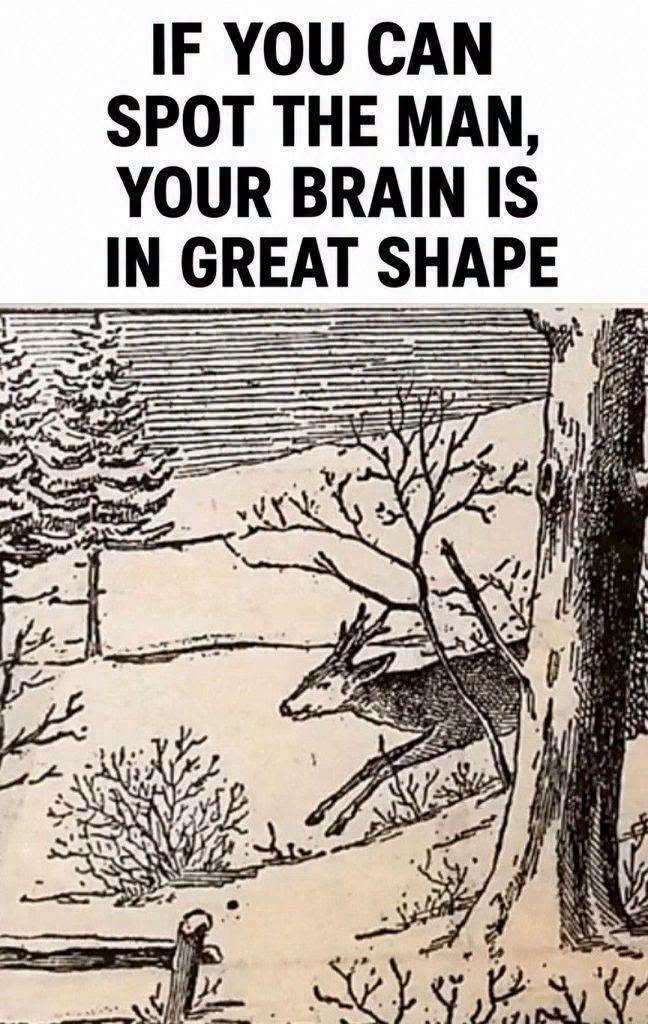
Visual perception is one of the most fascinating capabilities of the human brain. Everyday, our eyes gather millions of bits of optical information, transmitting raw signals through the optic nerve into the visual cortex. How we interpret these signals—and how quickly we can process hidden details within complex images—says a great deal about cognitive performance, pattern recognition, and focus. Visual brain teasers, hidden picture puzzles, and optical illusions have long captivated people of all ages, serving not only as popular entertainment but also as valuable mental exercises.
When you attempt to locate a hidden figure, such as a concealed hunter or an animal integrated into a forest landscape, your brain engages in rapid problem-solving. It filters out visual noise, contrast variations, and misleading lines to reconstruct a coherent image. Far from being a simple party trick, the ability to solve these visual puzzles relies on advanced neurological functions including cognitive sharpness, visual perception, and spatial reasoning.
The Science of Visual Perception and Optical Illusions
To understand why optical illusions and hidden picture puzzles are so challenging, it helps to examine how visual processing works inside the human brain. Vision is not merely a live camera feed; it is an active visual reconstruction built by your visual cortex.
When light reflects off an object, it hits the retina, where photoreceptor cells convert light waves into electrical impulses. These impulses travel along the optic nerve directly to the visual cortex located in the occipital lobe at the back of the brain. From there, the brain attempts to instantly match what you see with pre-existing patterns stored in your memory.
Object-Ground Perception and Camouflage
In visual psychology, one fundamental principle is “figure-ground perception.” This refers to the brain’s ability to simplify a scene into the main object we are looking at (the figure) and the background (the ground).
In traditional line drawings, artists intentionally manipulate negative space, contrast, and line contours to create optical tricks. When an image contains elements designed to conceal a visual clue—such as branches that double as facial features or tree bark that mirrors human silhouettes—the visual system experiences a brief sensory conflict. The brain must actively toggle between reading the picture as a landscape and recognizing individual object boundaries.
Gestalt Principles in Hidden Image Puzzles
Psychologists studying visual perception often reference the Gestalt principles of grouping, which explain how humans naturally organize individual elements into unified wholes. Key principles include:
-
Closure: The brain’s tendency to fill in missing visual information to perceive a complete shape.
-
Similarity: The tendency to group visual elements that share similar colors, textures, or shapes.
-
Good Continuation: The instinct to follow continuous lines or smooth patterns rather than jagged, broken angles.
When looking at a complex vintage illustration featuring trees, snow, and wildlife, your brain initially groups similar textures—such as bark lines and branch networks—together. Finding a hidden face or figure requires overriding these default Gestalt groupings to isolate secondary patterns embedded in the background.
How Visual Puzzles Benefit Brain Health and Cognitive Function
Engaging with brain teasers, visual visual search tasks, and logic puzzles offers numerous cognitive benefits. Just as physical exercise strengthens muscle fibers and supports physical longevity, mental stimulation helps support neural plasticity and cognitive flexibility.
       Visual Input (Retina)
                 │
                 ▼
       Visual Cortex (Occipital Lobe)
                 │
                 ▼
 ┌───────────────┴───────────────┐
 │                               │
 ▼                               ▼
Top-Down Processing       Bottom-Up Processing
(Expectations & Memory)  (Raw Visual Details)
 │                               │
 └───────────────┬───────────────┘
                 │
                 ▼
     Pattern Recognition & Solution
Enhancing Visual-Spatial Reasoning
Visual-spatial processing is the mental ability to perceive, analyze, and manipulate visual patterns and spatial relationships. Strong spatial skills are essential across numerous everyday tasks and professional fields—ranging from navigating unfamiliar routes to reading blueprints, operating equipment, and analyzing complex data displays.
Regularly solving optical illusions forces the brain to sharpen spatial awareness, teaching the visual system to discriminate subtle differences in angle, contour, and spatial orientation.
Boosting Mental Focus and Attention to Detail
In today’s fast-paced digital world, attention spans can easily become fragmented. Visual search puzzles require sustained, focused attention. To find a hidden detail in a busy image, you cannot simply skim the surface; you must scan methodically, analyzing micro-details while ignoring distractions.
This process exercises working memory and selective attention networks in the frontal lobe, helping train your mind to maintain concentration during detail-oriented tasks in daily life.
Supporting Neuroplasticity and Cognitive Reserve
Neuroplasticity refers to the brain’s remarkable capacity to reorganize itself by forming new neural connections throughout life. Engaging in novel, mentally challenging activities—such as learning a language, mastering an instrument, or regularly solving challenging brain puzzles—helps build cognitive reserve.
A robust cognitive reserve provides greater resilience against normal age-related cognitive decline, helping maintain sharp problem-solving capabilities, memory retention, and mental processing speed over time.
Practical Tips to Sharpen Your Brain and Solve Optical Illusions Faster
If you frequently enjoy testing your perception with visual riddles and optical illusions, adopting systematic scanning strategies can dramatically improve your speed and accuracy.
┌─────────────────────────────────────────────────────────────┐
│              METHODICAL VISUAL SCANNING STEPS               │
├─────────────────────────────────────────────────────────────┤
│ 1. Invert or Rotate: Change perspective to break patterns.  │
│ 2. Focus on Negative Space: Examine background shapes.       │
│ 3. Grid Scan: Systematically move row by row.              │
│ 4. Relax Focus: Shift from sharp detail to broad context.   │
└─────────────────────────────────────────────────────────────┘
-
Change Your Viewing Angle or Orientation: Many historical line puzzles utilize clever upside-down artwork. Inverting the image or turning your device sideways breaks the brain’s default visual expectation, making hidden shapes immediately stand out.
-
Examine Negative Space: Instead of focusing strictly on the foreground objects—such as animals or large trees—shift your attention to the negative spaces created between branches, trunk outlines, and ground contours.
-
Use Systematic Grid Scanning: Rather than letting your gaze dart randomly around the image, divide the picture into four equal quadrants or scan systematically from top-left to bottom-right, just as you would read a page of text.
-
Step Back or Adjust Distance: Sometimes being too close to a detailed line drawing makes it harder to notice broader structural outlines. Backing away or squinting slightly blurs fine textures, allowing full facial silhouettes or human figures to emerge from the background.
-
Relax Your Visual Focus: Alternate between tight visual inspection and a relaxed, wide-angle gaze. Softening your focus allows your peripheral vision and holistic pattern recognition to detect subtle, embedded shapes.
Fascinating Facts About Human Perception and Brain Teasers
-
The Origins of Vintage Hidden Pictures: Hidden figure art became immensely popular in late 19th-century trade cards and print magazines as interactive advertising tools to engage readers.
-
Speed of Visual Processing: Research shows that the human brain can process full visual images in as little as 13 milliseconds, rapidly categorizing complex real-world scenes before conscious awareness catches up.
-
Optical Illusions and Brain Scans: Functional MRI (fMRI) studies reveal that optical illusions activate both primary visual processing zones and high-level decision-making centers in the prefrontal cortex simultaneously.
-
Pareidolia Phenomenon: Human brains possess a deeply ingrained evolutionary mechanism called pareidolia, which causes us to perceive familiar human faces in random visual textures, such as tree bark, clouds, or rock formations.
-
Left vs. Right Hemisphere Involvement: While detail-focused processing relies heavily on the left brain hemisphere, broader spatial integration and holistic image recognition recruit right-hemisphere neural pathways.
Everyday Lifestyle Habits for Optimal Brain Health
While solving daily optical illusions and logic puzzles provides excellent cognitive workouts, long-term mental sharpness depends on comprehensive lifestyle habits. Maintaining holistic brain health requires a balanced approach combining physical wellness, proper nourishment, and continuous mental engagement.
                     ┌──────────────────────┐
                     │ OPTIMAL BRAIN HEALTH │
                     └──────────┬───────────┘
                                │
   ┌───────────────┬────────────┴───────────┬───────────────┐
   │               │                        │               │
   ▼               ▼                        ▼               ▼
Physical       Nutritional             Stress Management   Continuous
Activity        Support                    & Sleep          Learning
(Cardio/Flow) (Omega-3s, Antioxidants)   (7-9 Hours)     (Puzzles/Skills)
Nutrition and Hydration for Peak Cognitive Performance
Your brain consumes approximately 20% of your body’s energy despite representing only about 2% of total body weight. Fueling it with nutrient-dense foods supports sustained concentration and mental clarity.
Key dietary considerations for optimal neural health include:
-
Omega-3 Fatty Acids: Found in wild-caught fish, walnuts, and flaxseeds, these essential lipids form vital cell membrane structures within brain tissue.
-
Antioxidant-Rich Foods: Berries, dark leafy greens, and cacao help neutralize oxidative stress and maintain healthy cerebral blood flow.
-
Hydration Balance: Even mild dehydration (as little as 1-2% loss of body fluid) can impair attention, short-term memory, and processing speed.
Exercise, Sleep, and Stress Management
Physical movement directly stimulates the production of brain-derived neurotrophic factor (BDNF), a key protein that promotes neuron growth and synaptic plasticity. Engaging in moderate cardiovascular exercise for at least 150 minutes per week improves oxygen delivery to brain tissues and supports long-term memory function.
Quality sleep is equally vital. During deep sleep cycles, the brain’s glymphatic system actively clears out metabolic waste products that accumulate throughout the day. Aim for 7 to 9 hours of uninterrupted restorative sleep each night to ensure peak cognitive performance, clear decision-making, and sharp visual perception.
Conclusion
Visual perception puzzles, hidden image challenges, and optical illusions do far more than offer brief entertainment. They serve as engaging windows into the complex workings of human visual cognition, testing pattern recognition, spatial reasoning, and sustained focus. By regularly challenging your visual perception with brain teasers, maintaining healthy lifestyle habits, and staying curious, you actively support your brain’s natural flexibility and long-term cognitive vitality.
Frequently Asked Questions (FAQ)
What is an optical illusion?
An optical illusion is a visual experience where an image, color, or shape visually tricks the brain into perceiving something that differs from physical reality. This occurs because the visual cortex rapidly interprets lighting, contrast, angles, and shapes using past experiences and visual shortcuts.
How do visual brain teasers help my brain?
Visual brain teasers challenge your visual cortex and executive attention systems. They require you to override immediate visual impressions, focus on fine details, filter background visual noise, and improve spatial reasoning, which helps maintain mental agility and focus.
Why do some people spot hidden visual details faster than others?
Differences in visual search speed stem from several factors, including individual variations in visual acuity, visual working memory, pattern recognition experience, and selective attention control. Practice with visual puzzles can also improve speed over time.
What is pareidolia?
Pareidolia is the tendency of the human mind to perceive a specific, meaningful image—most commonly a human face—in a random visual pattern, such as seeing faces in clouds, rock formations, or wood grain textures.
How can I make hidden picture puzzles easier to solve?
To locate hidden elements faster, try rotating the image upside down, scanning the image systematically in a grid pattern, looking closely at negative space between objects, or stepping back to view the overall structure from a distance.
