
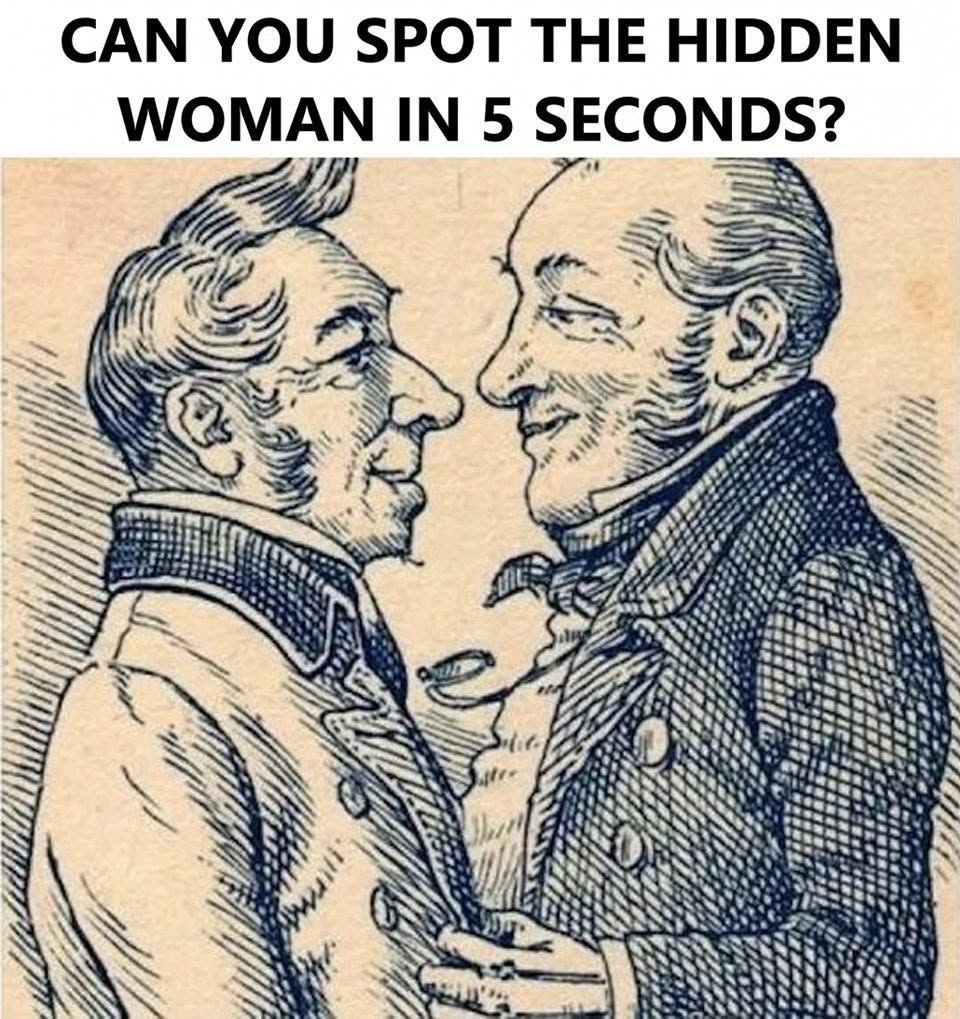
Have you ever looked at a simple vintage sketch or visual puzzle and found yourself staring for minutes, unable to spot a detail that someone else sees immediately? Optical illusions and hidden figure puzzles have captivated human curiosity for over a century. Beyond being entertaining brain games, these perceptual challenges offer deep insights into how the human visual system processes contrast, contour, negative space, and complex visual recognition.
When faced with an optical illusion—such as finding a concealed silhouette or a hidden woman embedded within a drawing of two men—your brain undergoes a complex process of visual interpretation. It must rapidly filter through competing visual information, disregard distracting details, and reconstruct a coherent mental image. Understanding how your visual cortex achieves this feat sheds light on key aspects of visual attention, cognitive performance, and spatial reasoning.
How the Brain Processes Visual Information and Negative Space
Vision is far more complex than simply recording images like a camera sensor. What we perceive as “seeing” is actually an active, constructive process executed by the brain’s visual cortex, located in the occipital lobe.
       Light Waves Signal Retina
                 │
                 ▼
       Optic Nerve Transmission
                 │
                 ▼
 visual Cortex (Occipital Lobe Processing)
                 │
                 ▼
 ┌───────────────┴───────────────┐
 │                               │
 ▼                               ▼
Foreground Recognition     Negative Space Analysis
 (Two Men's Faces)        (Concealed Silhouette)
 │                               │
 └───────────────┬───────────────┘
                 │
                 ▼
     Perceptual Shift & Solution Reveal
The Figure-Ground Relationship in Visual Art
One of the foundational concepts in Gestalt psychology is the figure-ground relationship. This concept describes how the human brain naturally segregates visual scenes into two distinct categories:
-
The Figure: The primary object or subject in focus, which appears closer and more defined.
-
The Ground: The background or surrounding context behind the focal object.
In classical optical illusions, artists intentionally manipulate negative space—the empty or secondary areas around and between the main subjects. In drawings featuring two men standing face-to-face, the negative space formed by their profiles, collars, or clothing folds creates a secondary outline. Because the brain defaults to identifying the dominant figures first (the two men), perceiving the secondary hidden profile requires a deliberate perceptual shift.
The Role of Top-Down vs. Bottom-Up Visual Processing
When analyzing a brain teaser, your visual system utilizes two primary processing pathways:
-
Bottom-Up Processing: This data-driven approach starts at the raw sensory level. Your retina detects basic visual elements such as lines, curves, high-contrast borders, and shading without initial context.
-
Top-Down Processing: Driven by memory, expectations, and cognitive context, this higher-level mental process uses prior knowledge to interpret incoming visual signals.
When someone tells you, “There is a woman hidden in this image,” top-down processing activates. Your brain immediately pulls up known geometric patterns and facial features—such as nose contours, lips, and hair outlines—and begins searching the canvas to match raw visual data with those mental templates.
Cognitive Benefits of Regular Brain Teasers and Visual Puzzles
Engaging regularly with optical illusions, hidden object challenges, and visual riddles does more than pass the time. It serves as an engaging cognitive workout that supports mental performance and brain resilience.
┌─────────────────────────────────────────────────────────────┐
│                 COGNITIVE IMPACT OF VISUAL PUZZLES          │
├─────────────────────────────────────────────────────────────┤
│ • Focus & Selective Attention: Enhances detail retention.    │
│ • Spatial Reasoning: Strengthens visual-spatial processing. │
│ • Neuroplasticity Support: Promotes new neural connections.  │
│ • Working Memory Engagement: Keeps visual templates active. │
└─────────────────────────────────────────────────────────────┘
Enhancing Selective Attention and Micro-Detail Processing
In an era dominated by rapid digital information streams, sustained focus can be difficult to maintain. Solving intricate visual search puzzles requires selective attention—the cognitive ability to focus on specific stimuli while filtering out irrelevant background noise. Training your mind to systematically scan detailed line art strengthens selective attention mechanisms, which are valuable for detail-oriented tasks in professional and academic settings.
Strengthening Visual-Spatial Reasoning and Cognitive Flexibility
Visual-spatial reasoning involves mentally perceiving, manipulating, and reorienting shapes and spatial relationships. When you turn an image upside down, adjust your viewing distance, or invert your focus from light to dark areas to locate a hidden figure, you practice cognitive flexibility. This flexibility enables your brain to drop incorrect assumptions and adopt fresh analytical approaches when solving everyday problems.
Supporting Neuroplasticity and Cognitive Reserve
The human brain possesses neuroplasticity—the ability to adapt, form new neural pathways, and reorganize connections throughout life. Mentally stimulating activities, including complex logic puzzles and visual challenges, contribute to building cognitive reserve. Maintaining a strong cognitive reserve helps protect brain function, preserving sharp memory retention and rapid processing speed as you age.
Proven Strategies for Solving Hidden Figure Illusions Faster
If you want to improve your speed and accuracy when solving optical illusions, adopting systematic visual search techniques can help you beat the clock every time.
-
Scan the Negative Space First: Instead of focusing on the main subjects, redirect your vision to the gaps, outlines, and blank areas between figures. Hidden profiles are frequently concealed in the negative contours formed by clothing, hair, or limbs.
-
Invert or Tilt Your Viewing Device: Changing the physical orientation of the image breaks your brain’s established pattern recognition habits. Flipping a picture upside down neutralizes primary object recognition, allowing secondary hidden shapes to immediately capture your attention.
-
Softening or Squinting Your Focus: Squinting reduces fine texture details and enhances general contrast boundaries. This makes macro-level outlines—such as the curve of a face or silhouette—stand out more clearly against busy background lines.
-
Use a Grid-Based Scanning Pattern: Rather than allowing your gaze to wander randomly across the image, divide the visual field into four distinct quadrants. Systematically analyze each quadrant from top to bottom, left to right.
-
Adjust Your Viewing Distance: Moving back from your screen or holding a physical page further away blurs minor line noise and allows your visual cortex to integrate separate visual elements into a single cohesive outline.
Interesting Facts About Optical Illusions and Human Perception
-
Victorian-Era Puzzle Cards: In the late 19th and early 20th centuries, hidden figure trade cards were widely distributed as interactive advertisements, combining artistic craftsmanship with clever perceptual tricks.
-
The Phenomenon of Pareidolia: Humans possess an innate evolutionary tendency called pareidolia, which prompts the brain to spot human faces in completely random shapes, such as tree bark, rock formations, or coffee stains.
-
Rapid Neural Processing Speed: Neuroscientific studies reveal that the brain can identify and categorize visual scenes in as little as 13 milliseconds, long before conscious perception fully processes the details.
-
Hemispheric Visual Processing: Detailed line analysis relies heavily on left-hemisphere neural networks, while holistic pattern recognition and spatial integration primarily engage the right hemisphere.
-
The Rubin’s Vase Effect: Created in 1915 by Danish psychologist Edgar Rubin, the famous “vase or two faces” illustration demonstrated how the brain toggles between figure and ground visual interpretations.
Healthy Daily Habits to Keep Your Mind Sharp and Focused
While brain teasers provide helpful mental stimulation, maintaining peak cognitive health requires a balanced approach to lifestyle and wellness. Adopting habits that nourish the brain supports long-term mental performance.
                     ┌──────────────────────┐
                     │ OPTIMAL BRAIN HEALTH │
                     └──────────┬───────────┘
                                │
   ┌───────────────┬────────────┴───────────┬───────────────┐
   │               │                        │               │
   ▼               ▼                        ▼               ▼
Physical       Nutritional             Stress Management   Continuous
Activity        Support                    & Sleep          Learning
(Cardio/Flow) (Omega-3s, Antioxidants)   (7-9 Hours)     (Puzzles/Skills)
Strategic Nutrition for Optimal Neural Function
The brain is an energy-intensive organ, consuming approximately 20% of your daily metabolic energy. Consuming nutrient-rich foods supports neural health and cognitive resilience:
-
Omega-3 Fatty Acids: Essential fats found in wild salmon, walnuts, chia seeds, and flaxseeds support cell membrane structure and neural signaling in brain tissue.
-
Antioxidant-Rich Foods: Blueberries, dark chocolate, spinach, and green tea contain rich flavonoids that protect brain cells from oxidative stress and support healthy cerebral blood flow.
-
Hydration Balance: Adequate water intake is essential for maintaining optimal cognitive performance. Mild dehydration can cause fatigue, reduced attention span, and slower processing speeds.
The Importance of Physical Exercise and Restorative Sleep
Regular cardiovascular exercise—such as brisk walking, cycling, or swimming—increases blood circulation and oxygen delivery to the brain. Exercise also stimulates the production of brain-derived neurotrophic factor (BDNF), a key protein that supports neuron survival and synaptic connection.
Equally critical is high-quality, restorative sleep. During deep sleep cycles, the glymphatic system clears metabolic waste products from brain tissue. Aiming for 7 to 9 hours of uninterrupted sleep each night helps consolidate memory, sharpens focus, and ensures your visual search capabilities remain at their peak.
Conclusion
Optical illusions and hidden figure puzzles offer a window into the human visual system. By challenging how we perceive negative space, figure-ground relationships, and subtle contours, these classic visual riddles show how active visual perception truly is. Combining regular cognitive challenges with healthy daily habits supports long-term mental acuity, sharp visual awareness, and cognitive flexibility.
Frequently Asked Questions (FAQ)
What is an optical illusion?
An optical illusion is a visual representation where perceived visual information differs from physical reality. Illusions occur when the visual cortex interprets contrast, shapes, lighting, and visual cues using visual shortcuts and past experiences.
How do visual hidden picture puzzles train the brain?
Hidden picture puzzles engage visual search mechanisms, selective attention, working memory, and visual-spatial reasoning. They require you to bypass primary visual focal points, filter out visual noise, and analyze negative space to identify concealed details.
Why do some people spot hidden figures much faster than others?
Individual differences in visual search speed depend on factors such as visual acuity, practice with spatial puzzles, top-down visual processing speed, and how easily a person can switch focus between figure and background elements.
What is negative space in art and perception?
Negative space refers to the area around and between the main subjects of an image. In optical illusions, artists frequently use negative space to form secondary hidden profiles, silhouettes, or shapes that only become visible when you shift your visual focus away from the main subjects.
How can I find hidden figures in visual puzzles more easily?
To locate hidden elements faster, try rotating or turning the image upside down, stepping back from the screen to blur fine lines, scanning the image systematically in a grid, or focusing specifically on the empty spaces between the primary figures.
