
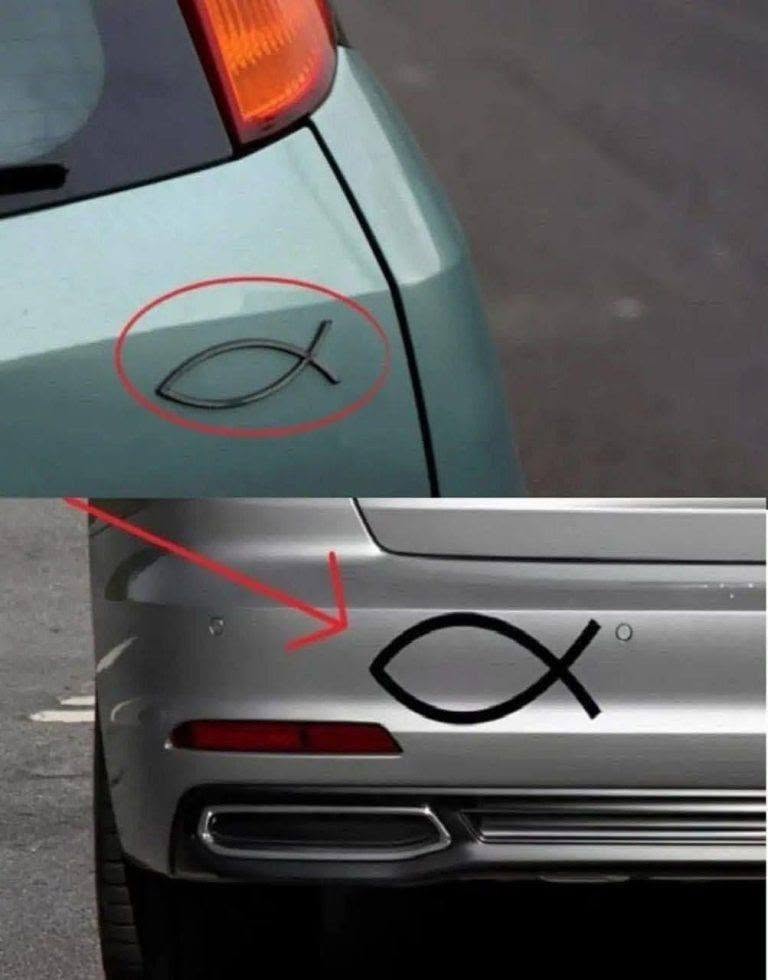
If you have spent any time driving on highways, sitting in city traffic, or navigating suburban parking lots, chances are you have spotted a simple, elegant emblem placed on the back of many vehicles. Shaped like two intersecting arcs that cross at one end to form the outline of a fish, this emblem—often referred to as the “Jesus fish” or Ichthys—is one of the most recognizable auto accessories in the world.
While millions of drivers recognize it today as a modern statement of faith, its true origins trace back thousands of years through secret codes, ancient languages, geopolitical oppression, and clever symbolic geometry. What started as a dangerous, underground handshake among early Christian communities in the Roman Empire has evolved into a global phenomenon with deep implications for culture, sociology, history, and automotive trends.
In this comprehensive exploration, we will delve into the secret history of the fish symbol, how it transitioned from ancient catacombs to car bumpers, the legal and commercial aspects surrounding religious symbols on property, and how simple vehicle accessories can impact auto insurance, personal security, and car resale values.
Ancient Origins: The Underground Secret Code of the Roman Empire
To truly understand why a fish emblem is placed on the back of a modern sedan or SUV, one must go back nearly two thousand years to the early centuries of the Roman Empire.
Persecution and the Need for Covert Communication
During the first three centuries AD, practicing Christianity within the Roman Empire was widely prohibited and frequently met with severe legal persecution, imprisonment, loss of property, or death. Because believers could not safely advertise their gatherings or identify themselves publicly, they developed a covert system of secret symbols, passwords, and visual signals to communicate safely.
The Secret Handshake of the Ancient World
Legend and historical accounts tell of how early believers used the fish outline as a secret code when meeting strangers along roads or in market squares:
-
One person would casually draw a single curved arc in the dirt or sand using their foot or walking staff.
-
If the stranger was also part of the underground community, they would draw a second matching arc intersecting the first, completing the distinct shape of a fish.
-
If the stranger did not understand the code, the first person could easily brush away the single arc in the dirt without drawing any suspicion from Roman authorities.
This simple geometric symbol allowed believers to identify safe houses, mark secret meeting places in underground catacombs, and build network connections without putting their lives at risk.
The Greek Acrostic: The Deep Meaning Behind “Ichthys”
Why specifically a fish? The choice was not random; it was a clever linguistic play on words using the Greek language—the lingua franca of the eastern Roman Mediterranean.
The ancient Greek word for fish is ΙΧΘΥΣ (transliterated as ICH THY S or Ichthys). Early scholars created an acrostic using each letter of the word to summarize core theological beliefs:
-
Ι — Iota (I): Standing for Ιησούς (Iesous), meaning “Jesus”.
-
Χ — Chi (X): Standing for Χριστός (Christos), meaning “Christ” or “Anointed One”.
-
Θ — Theta (TH): Standing for Θεού (Theou), meaning “of God”.
-
Υ — Upsilon (Y): Standing for Υιός (Yios), meaning “Son”.
-
Σ — Sigma (S): Standing for Σωτήρ (Soter), meaning “Savior”.
When joined together, the letters of the word for “fish” translated directly to: “Jesus Christ, God’s Son, Savior.” By drawing or carving a single fish shape, early practitioners could communicate a complex statement of belief instantaneously in a hidden, encrypted format that Roman guards could not easily decipher.
The Sacred Geometry and Pagan Antecedents
Long before the Ichthys became associated with Christian theology, the fish symbol held significant cultural, agricultural, and mathematical meaning across several ancient civilizations in Mesopotamia, Egypt, and Greece.
Symbol of Fertility and Abundance
In ancient Near Eastern cultures, fish were naturally associated with fertility, life, renewal, and abundance due to their incredible reproductive capacity and connection to water—the essential source of life in arid landscapes. Rivers like the Nile, Tigris, and Euphrates provided water for crops and fish for sustenance, making water creatures universal symbols of prosperity.
The Vesica Piscis
In geometry and ancient architecture, the overlapping shape created by two intersecting circles of equal radius is known as the Vesica Piscis (Latin for “bladder of a fish”). This mathematical ratio was widely used by ancient architects and builders to design sacred proportions, archways, and structural vaults. The central lens created by these overlapping circles forms the precise mathematical outline of the traditional fish emblem seen on vehicles today.
From Catacombs to Chrome: The Modern Bumper Emblem Phenomenon
How did an ancient secret code written in the dirt transition onto the polished trunk lids of modern automobiles? The answer lies in the evolution of 20th-century American car culture and consumer expression.
The Rise of Bumper Stickers and Auto Emblems
Following World War II, the rise of widespread personal vehicle ownership transformed the automobile from a simple transportation machine into a mobile canvas for personal identity. Drivers began decorating their cars with travel decals, political bumper stickers, and regional vanity badges to express their beliefs, hobbies, and affiliations.
In the late 1960s and 1970s, during religious revivals and youth cultural movements in North America and Europe, the ancient Ichthys symbol was rediscovered and popularized. Small business entrepreneurs began manufacturing adhesive metal and chrome-plated plastic fish emblems designed to match a car’s factory manufacturer badging (like Ford, Chevrolet, or Toyota).
The Cultural Parodies: Darwin, Science, and Beyond
As the traditional fish emblem became a permanent fixture on highways worldwide, it sparked a fascinating cultural dialogue through creative bumper parodies:
-
The Darwin Fish: Featuring the same fish outline but with small legs attached and the word “Darwin” inside, symbolizing acceptance of evolutionary biology.
-
The Gefilte Fish: A humorous cultural variation celebrating Jewish heritage.
-
The Flying Spaghetti Monster: A satirical symbol representing secular skepticism.
-
The Science Fish: Featuring the word “Science” inside an atomic or fish shape.
This public conversation played out on car bumpers around the world demonstrates how simple symbols continue to serve as dynamic tools for human expression, community identity, and intellectual debate.
Legal, Insurance, and Property Implications of Car Decals
While decorating your car with badges, stickers, or emblems is a popular personal choice, automobile owners should be aware of several practical legal, safety, and financial factors before applying accessories to their vehicle’s paintwork.
Vehicle Modifications and Auto Insurance
Installing small cosmetic emblems or adhesive badges does not typically affect standard auto insurance rates, as they do not alter the mechanical performance or safety structure of the vehicle. However, insurance policyholders should keep a few details in mind:
-
Vandalism Risk: In rare instances, displaying controversial political or ideological symbols on a vehicle can make the car a target for road rage or deliberate vandalism in public parking spaces. Comprehensive auto insurance policies generally cover intentional damage or vandalism, but drivers must pay their chosen out-of-pocket deductible before claims are settled.
-
Insurance Telematics and Theft Protection: Using discreet accessories or security devices is generally harmless, but driver visibility must never be obstructed. Placing large stickers on rear glass can block vision and create safety hazards that could affect liability in accident claims.
Paint Protection and Car Resale Value
Applying adhesive badges directly to a car’s painted bodywork requires proper care to prevent permanent cosmetic damage that could lower the vehicle’s resale or trade-in value:
-
Adhesive Degradation: Over time, cheap adhesives can bake into the vehicle’s clear coat under intense sunlight and heat, causing discoloration or paint chipping when removed.
-
Proper Removal Techniques: To safely remove a badge or emblem without damaging the underlying paint, use a household hairdryer to gently warm and soften the adhesive. Slide a piece of dental floss or fishing line behind the badge to cut through the glue layer, then clean any remaining residue using dedicated automotive adhesive remover and a soft microfiber towel.
Legal Protections in the Workplace and Business
Under constitutional protections and labor laws in many democratic nations, displaying non-disruptive personal or religious symbols on personal vehicles parked in employee parking lots is protected as private expression. Business owners and corporate fleet managers, however, often enforce strict uniform policies prohibiting personal decals or stickers on company-owned commercial vehicles to maintain a neutral brand identity.
Practical Tips for Applying and Maintaining Car Badges
If you choose to apply a decorative badge, chrome emblem, or decal to your vehicle, follow these practical steps for a clean, long-lasting installation:
-
Clean the Surface Thoroughly: Wash the application area with warm soapy water, followed by a light wipe with isopropyl alcohol to remove wax, dirt, and road grease.
-
Choose Flat Paint Surfaces: Apply rigid plastic or metal emblems to flat or slightly contoured metal body panels (like the trunk lid or tailgate) rather than flexible rubber bumpers or heated glass defroster lines.
-
Avoid Extreme Temperatures: Apply adhesive badges on temperate days (between 65°F and 85°F). Extreme cold prevents adhesives from bonding correctly, while extreme heat can distort lightweight plastic badges.
-
Protect the Finish: When washing your car, avoid blasting adhesive emblems directly with high-pressure pressure-washer nozzles, which can lift the edges and ruin the bond.
Fascinating Facts About Historical and Automotive Symbols
-
The World’s Oldest Car Emblem: The classic three-pointed star of Mercedes-Benz, registered in 1909, originally represented the brand’s ambition to dominate motor transport on land, sea, and air.
-
Subterranean Catacombs: In Rome alone, over 40 distinct underground catacombs stretch across hundreds of miles beneath the city, containing thousands of ancient carved fish, anchor, and olive branch symbols.
-
Modern Material Science: Today’s high-end auto emblems are crafted from ABS plastic electroplated with real metal coatings, allowing them to withstand harsh winter road salts, UV exposure, and car washes without rusting or fading.
Conclusion
The simple fish symbol displayed on the rear of millions of vehicles today is far more than a basic automotive accessory. It represents a continuous historical thread connecting modern digital society back to ancient secret societies, political resistance, linguistic cleverness, and sacred geometry.
Whether viewed through the lens of ancient history, theological acrostics, cultural dialogue, or personal identity, the Ichthys remains one of the most enduring and impactful symbols in human history. Understanding the deep story behind everyday sights enriches our perspective, reminding us that even the simplest shapes on the road carry centuries of human tradition, shared values, and historical memory.
Frequently Asked Questions (FAQ)
What does the Greek word Ichthys mean?
Ichthys (ΙΧΘΥΣ) is the ancient Greek word for “fish.” Early Christians used its letters as an acrostic standing for “Jesus Christ, God’s Son, Savior.”
Why did early Christians use the fish symbol instead of a cross?
During the first three centuries AD, the cross was not yet a widely used public symbol because crucifixion was still an active, gruesome form of Roman execution. The fish allowed believers to identify each other secretly without attracting immediate persecution from Roman authorities.
Can applying an adhesive badge damage my car’s paint?
If applied incorrectly or removed forcefully, heavy adhesives can pull off clear coat paint layers or leave stubborn residues. Warming the adhesive with a hairdryer and using dental floss to gently slice through the glue prevents paint damage during removal.
Is displaying personal symbols on a car covered by auto insurance?
The badges themselves are minor personal items, but if your car is vandalized because of a decal or emblem, comprehensive auto insurance usually covers the damage repairs, subject to your policy deductible.
What is the origin of the “Darwin Fish” symbol?
The “Darwin Fish”—a fish symbol with legs—was created in the late 20th century as a playful response celebrating scientific reasoning, biological evolution, and secular philosophy.
