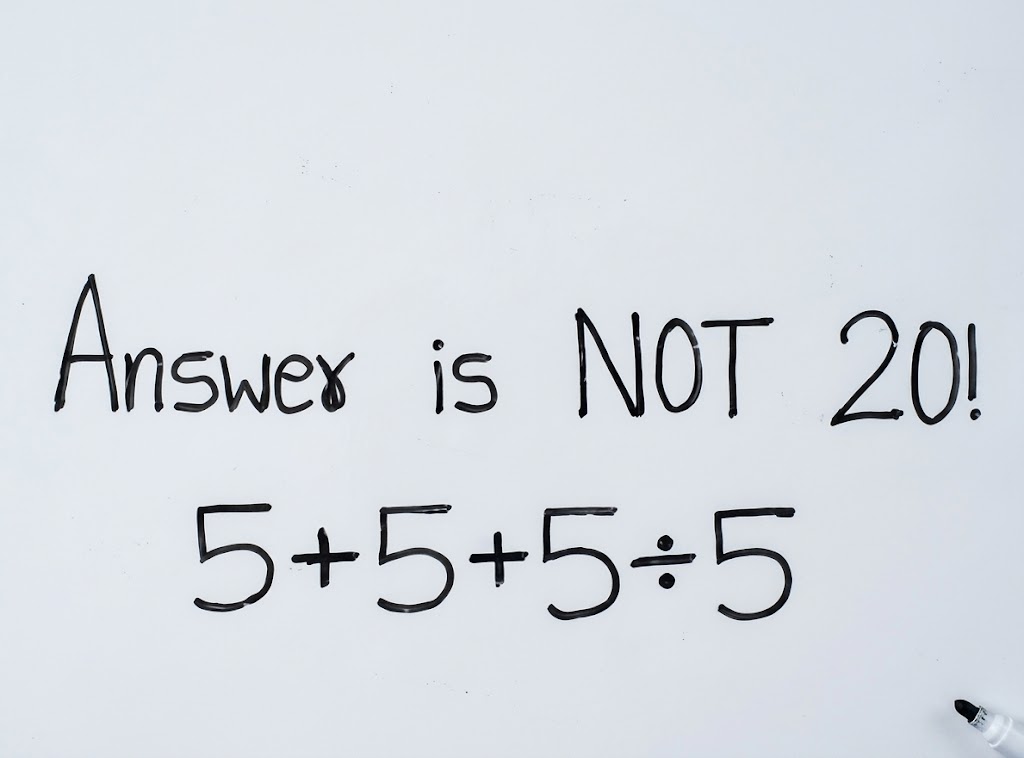
Here’s the challenge again:
5 + 5 + 5 ÷ 5
At first glance, it may be tempting to simply work from left to right:
5 + 5 = 10
10 + 5 = 15
15 ÷ 5 = 3
But that’s not how this expression should be solved.
Why?
Because mathematical operations follow a specific order.
The Trick Is the Order of Operations
When an expression contains different mathematical operations, you can’t always calculate everything from left to right.
Division comes before addition.
So instead of adding the first three 5s together,
we need to deal with the division first.
Look at the expression:
Look at the expression:
5 + 5 + 5 ÷ 5
First, solve:
5 ÷ 5 = 1
Now the expression becomes:
5 + 5 + 1
And that’s easy:
5 + 5 + 1 = 11
🎉 The correct answer is 11!
Why Isn’t the Answer 20?
This is where the puzzle catches people.
Someone might see four 5s and think:
5 + 5 + 5 + 5 = 20
But the fourth 5 isn’t being added.
It’s part of the division:
5 ÷ 5
That division must be completed before the additions.