
You lean in to apply moisturizer.
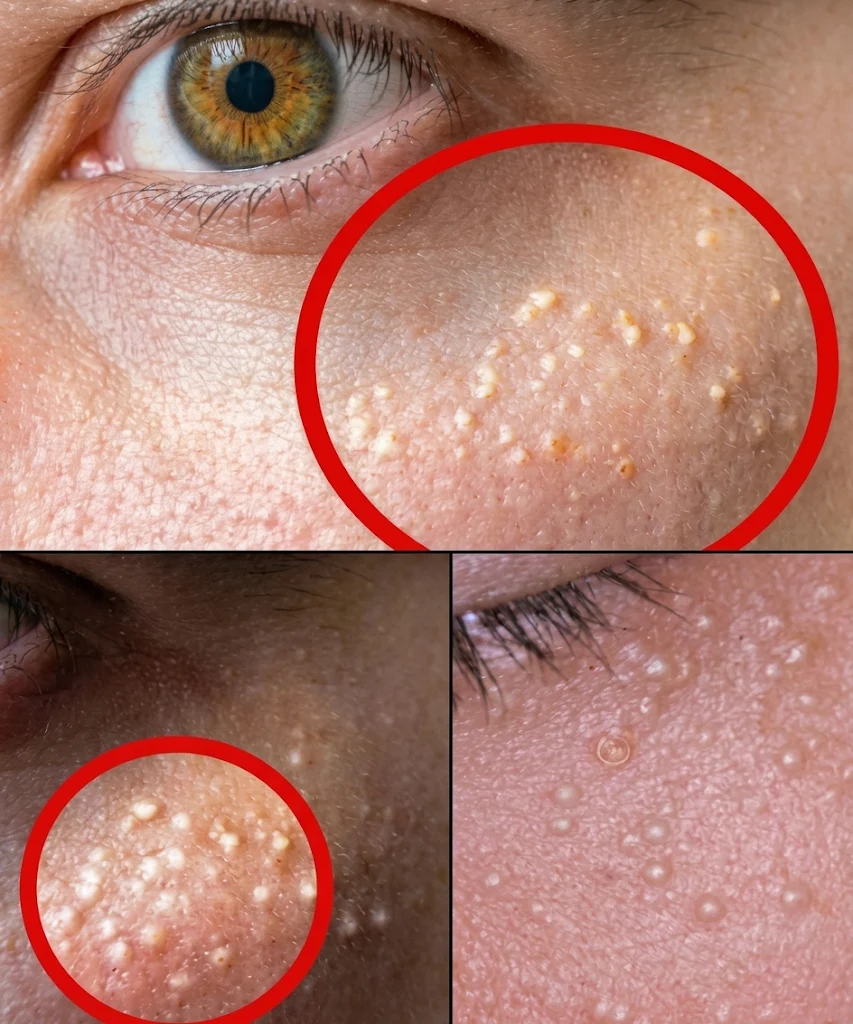
The light hits just right. And there they are: 👉 Tiny white dots clustered near your eyes, cheeks, or forehead.
They’re not acne. Don’t hurt. Don’t itch. But they won’t go away — no matter how many cleansers or serums you try.
Chances are, you’re dealing with milia — small, keratin-filled cysts that form under the skin.
While completely harmless, they can be frustrating — especially when you’re trying to achieve smooth, glowing skin.
Let’s explore what milia really are, why they appear (especially as we age), and what you can realistically do to manage them — so you can respond wisely, not aggressively.
Because real skincare isn’t about force. It’s about gentle understanding — one bump at a time.
🔬 What Exactly Is Milia?
Milia (singular: mille, meaning “thousand” in Latin) are small, firm, white bumps that range from 1–2 mm in size.
✅ They form when keratin — a protein found
in skin, hair, and nails — becomes trapped beneath the surface of the skin.
❌ Unlike acne, milia are not caused by oil or bacteria, and they don’t have an opening to the surface, which is why they don’t “pop.”
Common Types:
|
Type
|
Who It Affects
|
|---|---|
|
✅ Primary milia
|
Adults and newborns — forms in hair follicles or sweat ducts
|
|
✅ Secondary milia
|
After skin damage (burns, blisters, long-term sun exposure, or peels)
|
📌 Most common areas: Under the eyes, cheeks, nose, forehead — anywhere the skin is thin.
🧓 Why Do Milia Appear More Often With Age?
As we get older, our skin changes — and these shifts make milia more likely:
|
Cause
|
Why It Matters
|
|---|---|
|
✅ Slower cell turnover
|
Dead skin cells build up, trapping keratin
|
|
✅ Thinner epidermis
|
Easier for keratin to get stuck under fragile layers
|
|
✅ Sun damage over time
|
Damaged skin repairs poorly, increasing risk
|
|
✅ Use of heavy creams or occlusives
|
Can block pores if not
|
|
properly removed
|
💡 Milia aren’t a sign of poor hygiene — they’re often a natural part of aging skin.
❌ What Milia Are NOT
|
Myth
|
Truth
|
|---|---|
|
❌ “They’re whiteheads or pimples”
|
No — milia lack infection and pore connection
|
|
❌ “You can pop them like acne”
|
Dangerous — risks scarring, infection, and worsening
|
|
❌ “Only babies get milia”
|
False — adults commonly develop them too
|
|
❌ “They mean your face isn’t clean enough”
|
Not true — even meticulous routines don’t prevent them entirely
|
🚫 Never use needles, tweezers, or extraction tools at home — this can cause permanent damage.
✅ Safe Ways to Help Prevent & Reduce Milia
While you can’t always prevent milia, gentle habits may reduce their frequency:
1. Exfoliate Gently (But Regularly)
Helps remove dead skin before it traps keratin.
Look for:
- Chemical exfoliants: Low-concentration AHAs (like lactic acid) or BHAs (salicylic acid)
- Avoid harsh scrubs — they irritate delicate facial skin
🧴 Use 2–3 times per week, not daily.
2. Use Lightweight,
Non-Comedogenic Products
Heavy oils and thick creams (especially around the eyes) can contribute to clogged micro-channels.
Choose:
- Oil-free moisturizers
- Water-based serums
- Products labeled “non-comedogenic”
💧 Hydration matters — just pick formulas that absorb well.
3. Wear Sunscreen Daily
UV damage weakens skin structure and slows healing.
🌞 Use a broad-spectrum SPF 30+ every morning — even indoors.
🛡️ Prevention supports long-term skin health.
4. Keep Skin Clean — But Not Stripped
Over-cleansing disrupts the barrier, making skin more vulnerable.
🧼 Wash twice daily with a mild, pH-balanced cleanser. Rinse thoroughly and pat dry.
🩺 When to See a Dermatologist
While some milia fade on their own (especially in babies), adult milia often persist without professional help.
A licensed dermatologist or esthetician can safely remove milia using:
|
Method
|
How It Works
|
|---|---|
|
✅ Needle extraction
|
Sterile lancet creates tiny opening; milia are gently lifted out
|
|
✅ Cryotherapy
|
Rarely used — freezing small lesions
|
|
✅ Topical retinoids
|
Prescription creams (like tretinoin) that speed cell turnover
|
|
✅ Chemical peels or microdermabrasion
|
For multiple milia or prevention
|
⏱️ In-office removal takes minutes and is minimally invasive — but should never be done at home.
❌ Debunking the Myths About “Natural Removal”
Despite viral trends, there is no proven safe way to remove milia at home. Avoid:
|
“Remedy”
|
Risk
|
|---|---|
|
❌ Baking soda scrubs
|
Too abrasive — damages skin barrier
|
|
❌ Duct tape or glue pulling
|
Can rip live skin — causes scarring
|
|
❌ Toothpaste or lemon juice
|
Irritating and ineffective
|
|
❌ DIY lancing with pins
|
High risk of infection and permanent marks
|
🛑 Real beauty doesn’t come from quick fixes. It comes from patience, protection, and professional care.
Final Thoughts
You don’t need flawless skin to feel beautiful.
But you do deserve clarity — about what those little bumps are, and how to treat them with kindness.
So next time you’re staring in the mirror… pause.
Breathe. Accept the years, the sun, the life lived behind those eyes.
Then care —
gently, wisely, and without aggression.
Because real skin health isn’t about perfection. It’s about respect — for the surface, and everything beneath.
And that kind of grace? It glows brighter than any filter ever could.
