
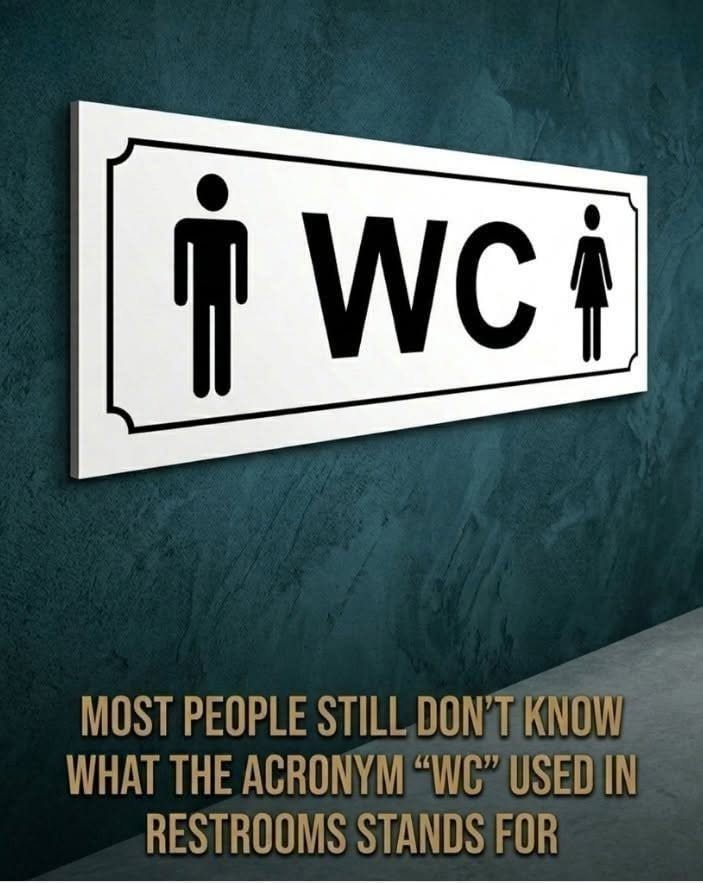
Have you ever walked down a bustling city street, entered an international airport, or traveled through Europe and noticed the simple two-letter abbreviation “WC” stamped across restroom doors? While billions of people pass these signs every single day, surprisingly few actually know what the initials represent. In an era dominated by modern terminology like “restroom,” “washroom,” or “bathroom,” the persistence of “WC” stands as a intriguing historical artifact.
Understanding where the term comes from is more than just solving a fun trivia question—it offers a fascinating glimpse into 19th-century public health, architectural evolution, social etiquette, and the engineering marvels that brought indoor plumbing into everyday human life.
The Origins of WC: Uncovering the True Meaning
To get straight to the point, WC stands for Water Closet.
While the term “water closet” sounds somewhat formal or archaic to modern American ears, it was once a revolutionary phrase. To understand why it was named this way, one must travel back in time to 19th-century Britain, when public sanitation and indoor residential plumbing were undergoing a massive transformation.
Why “Water Closet”?
Before modern plumbing existed, toilets were external facilities known as outhouses, latrines, or privy pits. When indoor plumbing began to take off during the Industrial Revolution, inventors needed a way to retrofit existing homes with flushable sanitation fixtures. Because space was limited, architects and homeowners repurposing older homes converted small, unused storage closets or pantry rooms into dedicated spaces for the new indoor toilet apparatuses.
Because these enclosed spaces featured a bowl connected to running water, they were literally named “water closets”—a closet or small room containing a water apparatus.
The History of Modern Sanitation and the Flush Toilet
The story of the water closet is deeply intertwined with the development of modern plumbing and civil health engineering. Understanding how society shifted from outhouses to indoor plumbing explains how the term gained such widespread popularity across the globe.
Early Antecedents
While flush toilets had existed in early forms—such as Sir John Harington’s 1596 design created for Queen Elizabeth I—they did not become commercially viable or widely adopted for centuries. Early versions lacked proper trapping mechanisms, meaning toxic sewer gas would often escape directly into living quarters.
Alexander Cumming and the S-Trap
In 1775, Scottish inventor Alexander Cumming patented the S-trap (later improved into the P-trap). This simple S-shaped bend in the pipe retained standing water, creating a seal that prevented unpleasant sewer gas from entering the house. This single mechanical innovation made indoor “water closets” safe and hygienic to install inside residential structures.
Thomas Crapper and Victorian Popularity
By the late 1800s, sanitary engineers such as Thomas Crapper, George Jennings, and Edward Johns perfected flush mechanisms and porcelain manufacturing. Thomas Crapper, whose name is often humorously linked to the slang word for toilet, popularized indoor water closets across the United Kingdom, holding several patents for plumbing improvements.
Why Is WC Used Internationally?
If the term originated in English-speaking Britain, why is “WC” so widespread across non-English speaking countries in Europe, Asia, Latin America, and Africa?
1. Etiquette and Polite Society
During the Victorian Era, public discussions involving bodily functions were considered highly taboo. Directly asking for the “toilet” or “latrine” was viewed as coarse and uncultured. Referring to the room as the “water closet” provided a polite, clinical euphemism that allowed individuals to excuse themselves discretely.
2. Standardization in European Tourism and Transit
As international travel expanded rapidly during the late 19th and early 20th centuries, hotels, railway systems, and municipal buildings needed a standardized symbol for international visitors. British hospitality and engineering standards were widely copied across Continental Europe at the time. The acronym “WC” was adopted as a universal signifier that bridged language barriers.
3. Linguistic Adoption
Many non-English languages adopted “WC” directly into their vocabulary as a loan word. For example, in French, Spanish, Italian, German, and Romanian, signage consistently displays “WC” even though the native translations for water and closet are completely different words.
How Restroom Terminology Varies Worldwide
Language evolves based on culture, geography, and social norms. Depending on where you travel, you will encounter vastly different words for the exact same facility:
-
United States: “Restroom” is the most common public term, while “bathroom” is predominantly used in private homes. “Washroom” is also common in regional dialects.
-
Canada: “Washroom” is the preferred neutral public signifier.
-
United Kingdom: “Loo” is popular informal slang, while “toilet” or “WC” is standard for public facilities.
-
Australia & New Zealand: “Dunny” (informal outdoor toilet) or “toilet.”
-
Japan: “Otearai” (hand-washing room) or “Toire.”
The Modern Plumbing Revolution: From Sanitation to Real Estate
The development of the water closet did far more than clean up city streets—it completely reshaped residential architecture, urban design, health policies, and economic value in modern real estate.
Architectural Transformations
Before the widespread adoption of the water closet, residential floor plans did not allocate dedicated space for sanitation within main living areas. The invention of indoor plumbing completely transformed residential architecture. Bathrooms grew from small converted closets into expansive room layouts featuring modern ventilation, ceramic tiles, and complex drainage systems.
Impact on Public Health
The widespread installation of municipal water closets directly correlated with dramatic declines in infectious diseases such as cholera, typhoid, and dysentery. Urban centers that invested heavily in modern sewage infrastructure and public water closets saw immediate increases in life expectancy and overall public safety.
Value in Modern Real Estate and Business
Today, access to reliable, hygienic restroom facilities is an essential metric in commercial and residential property valuation. Whether analyzing real estate investments, commercial business licenses, or hospitality regulations, building codes mandate minimum restroom facilities based on occupant capacity.
Proper maintenance of restrooms in commercial facilities also protects businesses against potential legal liabilities and health code violations, ensuring that property owners maintain clean, compliant spaces for public use.
Practical Tips for Traveling Internationally
If you are planning an international trip, understanding local bathroom customs and signage can make your journey significantly smoother:
-
Look for the “WC” Sign: When traveling through airports, train stations, or tourist areas in Europe and Asia, follow “WC” directional signs.
-
Carry Small Cash or Local Currency: In many countries, public WCs require a small fee (often 0.50 to 1 euro) to enter or access toilet paper.
-
Know the Local Symbols: In addition to “WC,” pay attention to localized icons. Some countries use stylized figures, while others may use geometric shapes (like circles and triangles) to distinguish gender-designated facilities.
-
Learn Key Phrases: Memorize basic local phrases for asking directions to the restroom (e.g., “Où sont les toilettes?” in French or “Wo ist die Toilette?” in German).
Fascinating Facts About Water Closets and Restroom History
-
The First Modern Flush Patent: The first formal patent for a flush toilet was granted in 1775 to Scottish watchmaker and engineer Alexander Cumming.
-
Royal Luxury: Sir John Harington built a prototype flush toilet for Queen Elizabeth I in 1596, but the Queen reportedly found it too noisy to use frequently.
-
Global Plumbing Codes: Modern plumbing codes require specific ratios of WCs to occupants in public venues such as stadiums, restaurants, and shopping malls.
-
Space-Saving Designs: In modern high-density urban apartments, compact “tankless” water closets use direct high-pressure plumbing valves to save valuable interior square footage.
The Environmental Evolution of the Water Closet
As environmental awareness grows worldwide, the humble water closet is undergoing its biggest transformation since the Victorian Era. Early water closets used as much as 5 to 7 gallons (19 to 26 liters) of water per flush. Modern high-efficiency toilets (HET) have reduced that volume dramatically to 1.28 gallons (4.8 liters) or less.
Innovations such as dual-flush technology allow users to select different water volumes depending on waste type, saving thousands of gallons of water per household each year. Furthermore, intelligent toilets featuring built-in bidets, self-cleaning UV lighting, and automated water-saving sensors represent the next generation of personal hygiene technology.
Frequently Asked Questions (FAQ)
What does “WC” stand for on restroom doors?
“WC” stands for Water Closet, an early term for a small room containing a flushable toilet with running water.
Why don’t Americans use the term “WC”?
American English evolved to favor soft euphemisms such as “restroom” or “bathroom.” The term “water closet” fell out of common spoken usage in North America during the 20th century, though it still appears in local building codes and technical architectural blueprints.
Is “WC” still used today?
Yes! “WC” is extremely common across Europe, South America, Asia, and Africa. It serves as a universally recognized international symbol for public toilet facilities.
What is the difference between a toilet and a water closet?
Technically, the “toilet” refers to the actual physical porcelain fixture, whereas the “water closet” originally referred to the enclosed room or space housing that fixture. Over time, the terms have become largely interchangeable in everyday conversation.
Conclusion
The next time you spot a “WC” sign while traveling or browsing an international venue, you will know the rich history behind those two simple letters. From converted 19th-century storage closets and Victorian engineering triumphs to global sanitation standards and high-tech water-saving fixtures, the water closet has played a vital role in shaping modern human civilization. What began as a polite Victorian euphemism remains one of the world’s most recognizable symbols for comfort, hygiene, and public health.
